
Randolph County Three-Day Feed
No official visible 72-hour release list was found on the Randolph County Sheriff's Office website. The same research found no 48-hour list, current-inmate roster, recent-arrest page, jail-inmate search, or public booking-photo feed. The website therefore supplies no confirmed rolling period, “last updated” marker, refresh interval, or rule for when a released person's entry disappears.
Do not infer a three-day archive from practices in larger counties or from a commercial jail vendor. Randolph County may retain jail records under government schedules even though it does not post them online. The correct claim is narrow: no public rolling release archive was located. The sheriff and the court remain the source channels for an individual event.
Why Randolph's 72-Hour Window Matters
A 72-hour review is most useful when the exact release day is unclear. A Friday bond, a weekend hearing, late paperwork, or a holiday can place the key event outside a strict 24-hour check. With no local feed, the wider window becomes a date range for a focused inquiry. Give the sheriff an approximate booking date and ask whether custody ended at any point within those three calendar days.
The court file may clarify sequence. A bond order can precede the physical release while processing is completed. A sentence entry can show time served, yet another hold can delay departure. A dismissal can end one charge while a second case keeps the person in custody. For that reason, compare the jail's release time with the order or docket entry rather than assuming both occurred at once.
Does a court order prove the person walked out? Not by itself. The order explains legal authority, while the jail record establishes the local custody endpoint and may reveal a hold or transfer.
Check Randolph County Three-Day Releases
Use a date-bounded process. It gives staff a useful search range and avoids requesting a broad list the agency does not publish. If the person was never booked locally, move to the system that actually held the person.
- Confirm the Georgia agency at the sheriff contact page. Note the Cuthbert address and 229-732-2525 phone.
- Provide the full name, date of birth when known, arrest or booking date, and the three-day period at issue.
- Ask whether the person remained in Randolph County custody, left for the community, or transferred to another authority.
- Request the release date, exact time, type, booking number, charges, case number, and destination note if documentary proof is needed.
- Compare the Randolph County court docket for a bond order, disposition, sentence, revocation entry, or dismissal.
- Follow a transfer through GDC, another county, BOP, or DHS rather than recording it as a community release.
For a single same-day question, the 24-Hour Release List page offers the shorter workflow. The three-day approach is better when the event may have crossed a weekend or when the date supplied by family, counsel, or an alert is approximate.
Randolph County 72-Hour Record Fields
The sheriff does not confirm these as columns in a web table. They are the useful fields to name in a records inquiry. Specific wording lowers the chance that the office must interpret “all recent releases” as a request for a new compilation.
| Requested field | Use in a three-day review |
|---|---|
| Name and birth identifier | Distinguishes the correct individual. |
| Booking date and number | Ties the release to one custody episode. |
| Release date and exact time | Places the event within the 72-hour range. |
| Release type or reason | Separates bond, time served, dismissal, and transfer. |
| Charge and court case | Connects jail data to the controlling court file. |
| Hold or destination note | Shows whether another authority received the person. |
Release types change the next step. Bond normally leaves a pending case. Time served ends the local jail term, but probation or another form of supervision may begin. Transfer means the person stopped being a Randolph County detainee without becoming free. If the record gives only a code, ask the jail what the code means or use the court entry for the legal reason.
Weekend Randolph Release Processing
No local source states that Randolph County releases occur at fixed hours or that weekend records are posted on a set cadence. Do not promise a time, an exit point, or instant website publication. The Gary Yochum, Sr. Law Enforcement Complex contains intake and court-related infrastructure, including courtroom seating described for Magistrate, Probate, and Superior Court hearings. That local arrangement makes hearing outcomes relevant, but it does not establish when physical release processing finishes.
When the 72-hour period includes Saturday or Sunday, record both the court event and the jail departure. A Friday order may be followed by later administrative steps. Property return, identity checks, bond processing, and an unresolved hold can affect the sequence, but the research does not establish a Randolph-specific processing schedule. The safest inquiry is factual: “What date and time did Randolph County custody end, and was the person released or transferred?”
Note: A three-day range catches date uncertainty; it does not turn a court order or an automated alert into a certified jail release record.
Wrong-State Randolph Roster Warning
The strongest local data quirk is a search result that looks useful but belongs elsewhere. Randolphcountyso.org displays an inmate roster with photos and booking information, yet its page identifies the agency as Randolph County, Alabama. That roster cannot establish custody or release in Cuthbert, Georgia. Names can overlap, and the county label alone is not enough.
The Alabama roster capture makes the state mismatch visible.
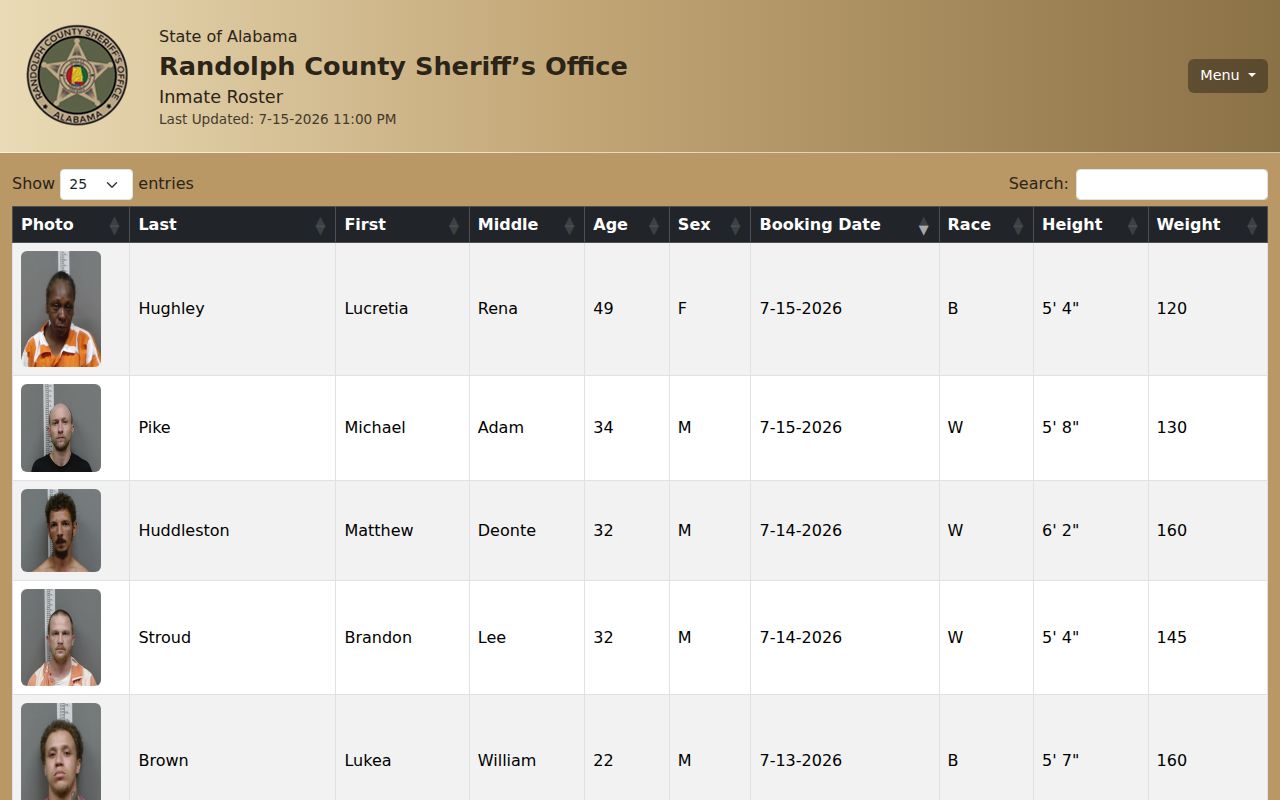
Use randolphgasheriff.org for the Georgia sheriff. Its current contact location is 216 Recreation Camp Road, Cuthbert, GA 39840. A result tied to an Alabama agency, Alabama address, or Alabama state label must be rejected even if the heading says “Randolph County.”
Trace Randolph County Custody Endpoints
A three-day review should end at the correct system. For a local bond or completed jail term, use the sheriff release record and Randolph County court file. For a transfer to the Georgia Department of Corrections, open GDC Find an Offender. Its state-prison record is distinct from the county jail. For parole, use the Parole Board tools and the Department of Community Supervision office that serves Randolph County.
| Custody endpoint | Follow-up source |
|---|---|
| Community after local release | Sheriff record and court disposition |
| Georgia state custody | GDC offender search and Inmate Records |
| Parole or felony probation | Parole Board and DCS Donalsonville |
| Participating custody alert | Georgia VINE, then originating agency |
| Federal prison custody | BOP Inmate Locator |
| Immigration custody | ICE locator or DHS-VINE |
Georgia VINE is an alert and status channel, not a release archive. Local participation should be confirmed because the sheriff site does not state that Randolph County Jail feeds VINE. A GDC result applies to state offenders, not someone who merely bonded out of the county jail.
Document Randolph County Past Releases
A written request is the durable fallback when the three-day period has passed. Randolph County's sheriff site posts no release form or fee schedule. Contact the office first to confirm its current submission method. Ask for the smallest set of existing fields that answers the question rather than a newly prepared report of every person released.
For a three-day range, first ask whether an existing release report or booking log already covers those dates. Georgia law does not require the sheriff to create a new summary. If no report exists, an individual request tied to one name and booking is the clearer path. For a broader request, ask for an estimate before authorizing search, review, redaction, or copy work. Also state whether the range uses calendar dates and include the approximate booking date so staff can identify the correct custody episode.
The Georgia Open Records Act overview notes that not all government material is public and agencies need not create a record that does not exist. O.C.G.A. 50-18-71 addresses inspection, copies, response timing, and lawful costs. A narrow request can name the person, approximate booking date, the 72-hour range, and the release time, reason, booking number, case number, and destination sought.
For an older event, court records may outlast public-facing jail information. The clerk file can document the bond, plea, verdict, sentence, probation terms, revocation, dismissal, or discharge entry. It does not replace the jail timestamp, but together the two records explain both why custody could end and when Randolph County custody actually ended.