
Randolph Parole and Probation
Georgia assigns parole and probation in different ways. The State Board of Pardons and Paroles explains that probation is an act of the court. A judge may order it instead of prison for all or part of a sentence. Parole is granted only by the Board after a person has served part of a state prison sentence. A Randolph County jail detainee who bonds out has not necessarily begun either form of supervision. The criminal case may still be pending. A person who finishes a local jail term may have probation to serve, while someone discharged from a GDC prison may leave on parole or at the end of the full sentence.
The record source follows that difference. A Randolph County probation term is confirmed through the sentencing case and the Georgia Department of Community Supervision when it is felony supervision. A parole term is checked through the Parole Board's parolee database and then confirmed with DCS. Misdemeanor probation can involve a court or local provider, so the Randolph County clerk is the first stop for those cases. The word discharge means custody or supervision has formally ended. It should not be inferred merely because a name disappears from a search.
Release status and supervision status can also overlap without matching. A person may be out of Randolph County Jail on bond with no probation term yet. Another person may have completed prison custody but remain under parole. A third may finish confinement and begin a court-ordered probation term. Write down the source, status label, and date for each result. That small record helps separate a jail custody endpoint from a supervision start or final discharge.
| Question | Parole | Probation |
|---|---|---|
| Who orders it? | Georgia State Board of Pardons and Paroles | Sentencing court |
| What comes first? | Part of a state prison sentence | A court sentence, with or without confinement |
| Best public record | Parolee database and Board record | Court docket, sentence, and DCS record |
| Randolph service point | DCS Donalsonville | DCS Donalsonville for felony probation |
- Parole
- Conditional community release granted by the Parole Board after part of a prison term.
- Probation
- Court-ordered community supervision imposed as part of a sentence.
- Discharge
- The formal end of custody or a supervision term.
- Absconder
- A supervised person whom the responsible agency reports as missing from supervision or wanted for a supervision failure.
Verify Randolph Post-Release Supervision
Start with the type of custody, not with a broad name search. Randolph County Jail, the Georgia Department of Corrections, and a federal prison are separate systems. The GDC Offender Query helps identify a state-prison record. The Parole Board's public parolee search is the post-release parole tool, while the inmate TPM lookup serves a person who is still in prison and awaiting parole review. A Tentative Parole Month is not proof that parole began.
- Confirm whether the person left Randolph County Jail, a GDC prison, or federal custody. Use identifiers such as full name, birth date, case number, or GDC ID.
- For state prison, review the GDC record and its custody or release fields. Compare the photo and sentence details when available.
- Search the Georgia parolee database for current parole status, supervision dates, and any displayed wanted indicator.
- For felony parole or probation serving Randolph County, contact DCS Donalsonville to confirm the proper reporting office and lawful record channel.
- Use the Randolph County court docket for probation terms, revocation entries, amendments, or a discharge order. Misdemeanor cases should begin with the sentencing court.
Names can match. Compare several identifiers before relying on a result. A court sentence may include both confinement and probation, and a GDC transfer means the person left county custody without returning to the community. The full Randolph County release search explains how sheriff, court, and corrections records fit together. For date questions tied to a person still in prison, use the Randolph County projected release date process.
Randolph Supervision Office Is Regional
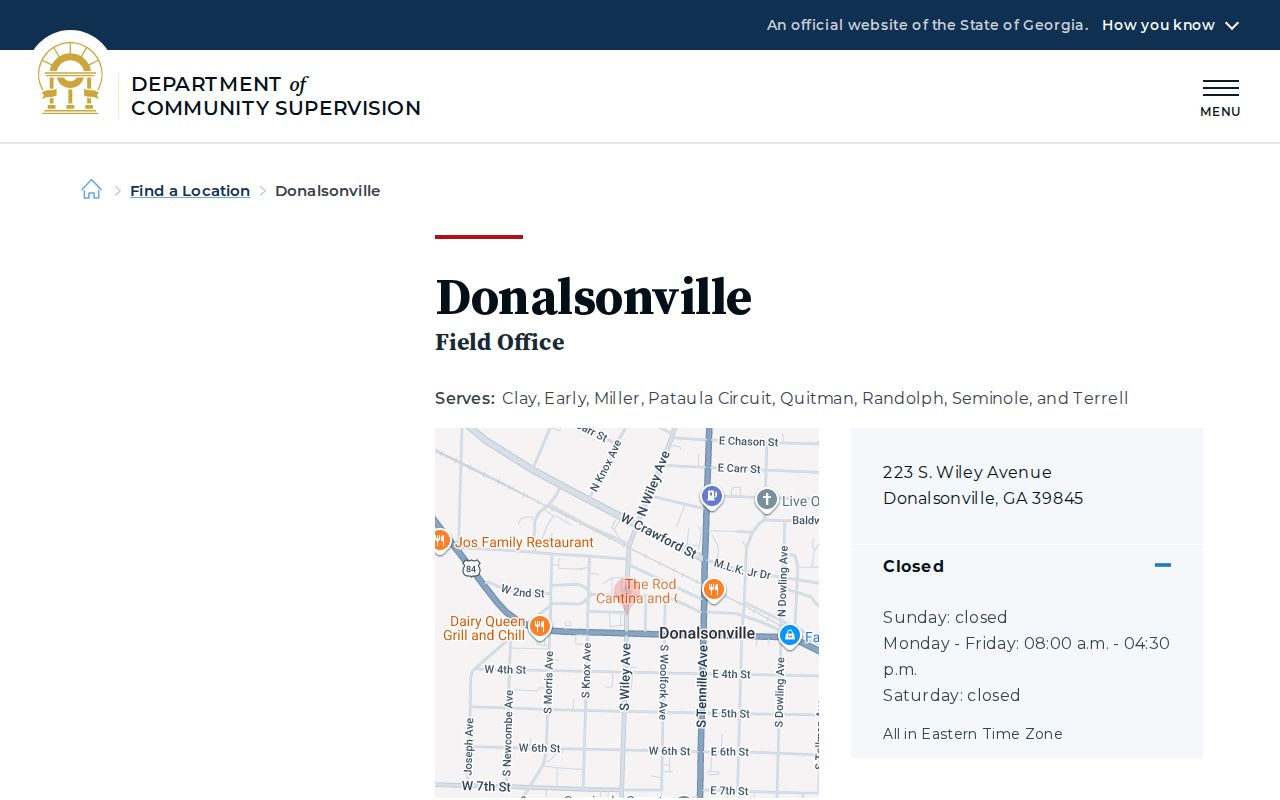
Randolph County does not have a Randolph-only felony supervision office in Cuthbert. The DCS Donalsonville Field Office serves Clay, Early, Miller, the Pataula Circuit, Quitman, Randolph, Seminole, and Terrell counties. That regional structure matters. A person whose case arose in Randolph County may report in Donalsonville, so the absence of a Cuthbert DCS listing does not mean supervision ended or that the record is wrong.
Donalsonville Field Office
223 S. Wiley Avenue
Donalsonville, GA 39845
Phone: 229-524-2836
Fax: 478-216-2085
Monday through Friday, 8:00 a.m. to 4:30 p.m.
Statewide DCS: 678-783-4337
The office can route questions about felony probation and parole supervision. It is not the source for a county jail release time, a court-certified sentence, or a pre-release prison calculation. Ask only for the record or office needed. DCS may limit personal details, and public database results should be checked against the agency that created them.
If the Donalsonville office is not the current reporting point, ask DCS to identify the office shown in the active record. Supervision may move after an approved address change or transfer. The county of conviction, county of residence, and reporting office can therefore differ. That does not by itself show an error.
The official DCS office page shows the Randolph-serving regional location and its service counties.
Randolph Parole Eligibility Is Not Release
Parole eligibility belongs to the state-prison process. The Board says most parole-eligible people become eligible for consideration after one-third of a prison sentence. That point only permits review. It does not require release. The Board may set a Tentative Parole Month, deny parole, postpone review, or change an earlier decision before release. For specified non-life serious violent felonies with crime dates on or after January 1, 1995, Board materials state that the prison term imposed by the judge must be served in full and parole is unavailable.
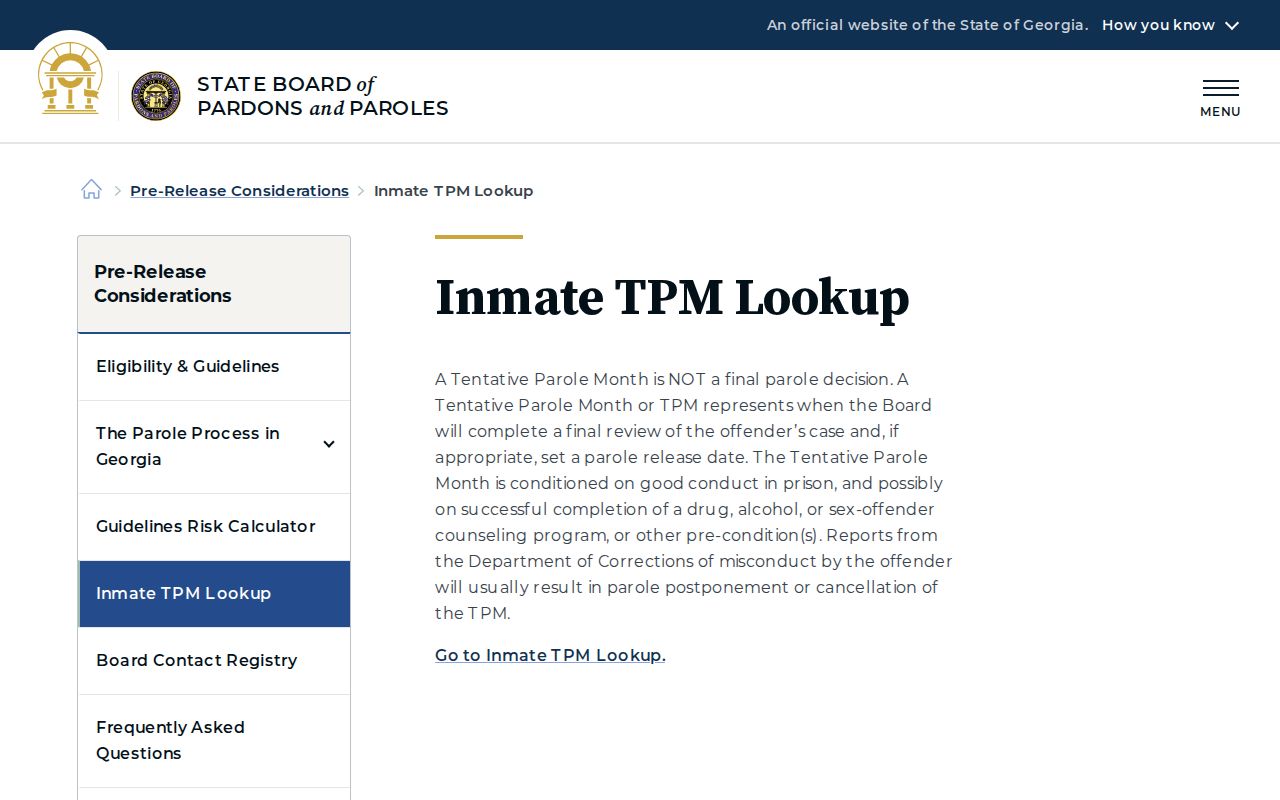
A TPM is a target month for final Board review. Good conduct and required programming can affect it. Misconduct may postpone or cancel it. Life-sentence eligibility also varies by offense date and sentence type. These rules explain why a family member may see an eligibility point without finding a firm release day. The custody agency and Board record must supply the final answer.
The Board's TPM page defines the tentative month and its limits.
Randolph Absconder Status Needs Verification
An absconder indicator is a supervision status, not a new conviction. It can mean the supervising authority cannot locate the person or reports a failure to comply with supervision. The live Parole Board or DCS record is the proper verification path. The Randolph County Sheriff's Most Wanted page should not be treated as a current parole or probation absconder list. Its posted text says all listed most-wanted persons had been apprehended as of October 2017 and that the page would change if needed.
This local detail prevents a common error. A blank or old sheriff page does not clear a person from a state supervision flag, and a parolee database indicator does not prove a fresh criminal judgment. Check the status with the displayed parole office or DCS. If a court issued a probation warrant or entered a revocation, the court record may also show that action. A revocation is a court or Board action that cancels community supervision and can return a person to custody.
Randolph Supervision and Release Alerts
Georgia has more than one notification channel. Georgia VINE provides custody-status searching and alerts for participating records. It may help when a Randolph County jail or state custody record appears, but the county sheriff site does not state that the local jail feed is integrated. A missing or stale result should be checked with the sheriff or custody agency.
The Parole Board's Victim Information Program is separate. Its automated line can provide a state offender's incarceration location, parole status or eligibility, maximum or scheduled release date, and an indication that the person is not in custody when the caller has the required case or GDC identifier. Neither service replaces a certified court order, jail release record, or DCS supervision record. Notifications are prompts to verify a change.
How Randolph Supervision Ends
Supervision ends through a formal agency or court event. A probation discharge may appear in the sentencing docket or an order. A parole discharge comes through the Board and supervision agencies. Reaching an expected date is not enough if a tolling event, warrant, revocation, amended sentence, or other lawful change affected the term. Tolling means the running of a period is paused under the controlling rule or order.
For a useful record, ask for the supervision type, start and end dates, current status, supervising office, and any public discharge or revocation entry. Georgia's Open Records Act permits access to government records but does not make every detail public. Narrow requests are more likely to identify an existing record. Sensitive details may be withheld or redacted. The best final proof comes from DCS, the Board, or the sentencing court, depending on who owns the supervision action.