
Randolph Scheduled Versus Actual Release
A projected date is a forecast based on the record as it stands. An actual release date records when custody ended. In Randolph County Jail, a pretrial person usually has no sentence-based projected release day. Release may depend on bond, dismissal, a court order, transfer, or another authority's hold. A sentenced local detainee may have a date computed from the judgment, jail credit, and local custody records, but no official Randolph County good-time policy was found in the research.
State prison uses more than one label. The Georgia Department of Corrections may refer to a maximum or scheduled release date. Its Performance Incentive Credit material uses Maximum Release Date, or MRD. The State Board of Pardons and Paroles uses Tentative Parole Month, or TPM. MRD relates to the sentence and state custody calculation. TPM identifies a month for final parole review. It is not a promised exit date. A final parole release date may be set only after that review.
The release event should be checked after it occurs. A county jail transfer can remove someone from local custody without releasing that person into the community. The receiving agency then becomes the source for the next custody date.
Keep a copy of the field name and the date it was viewed. Public search data can change after a sentence correction or Board action. A screenshot or note does not freeze the calculation, but it helps the records office understand which older value needs explanation. If two official systems differ, ask each agency what its field measures before deciding that either one is wrong.
Find a Randolph Release Date
Choose the path by custody type. The Randolph County Sheriff's Office and court own local jail and case facts. GDC owns the state-prison record. The Parole Board owns TPM and parole decisions. A broad web search can mix Georgia with another Randolph County, so begin with an official Georgia source and compare identifiers.
- Confirm whether the person is in Randolph County Jail, GDC custody, federal custody, or another agency's custody. A transfer note may explain why a local record ended.
- For county jail, call the Sheriff's Office and ask for current status, release date if set, and the release-causing event. Check the Randolph County court docket for bond, sentence, dismissal, or an amended order.
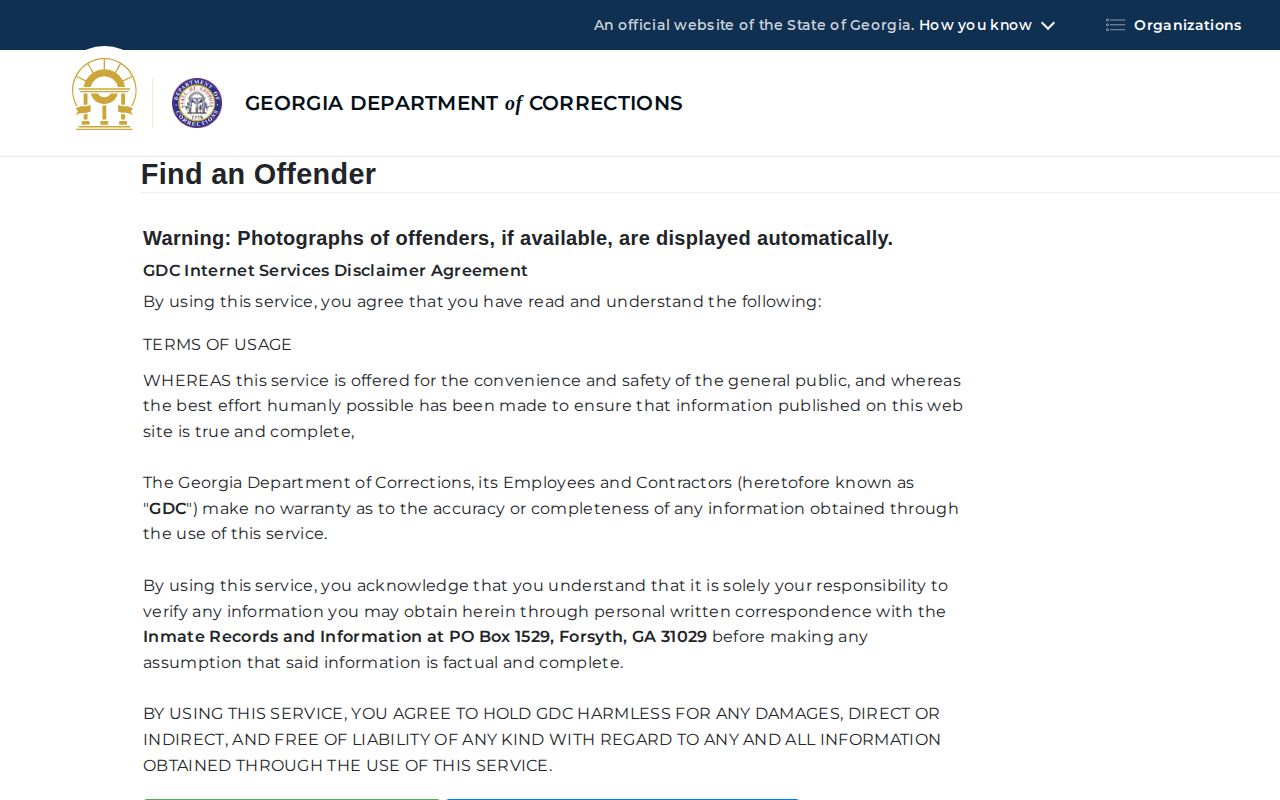
- For state prison, open GDC Find an Offender, choose Offender Search, and search with an exact name or GDC ID when possible.
- Compare the GDC ID, age or birth data, physical description, conviction county, sentence, offense, facility, and photo if available. Read each date label exactly.
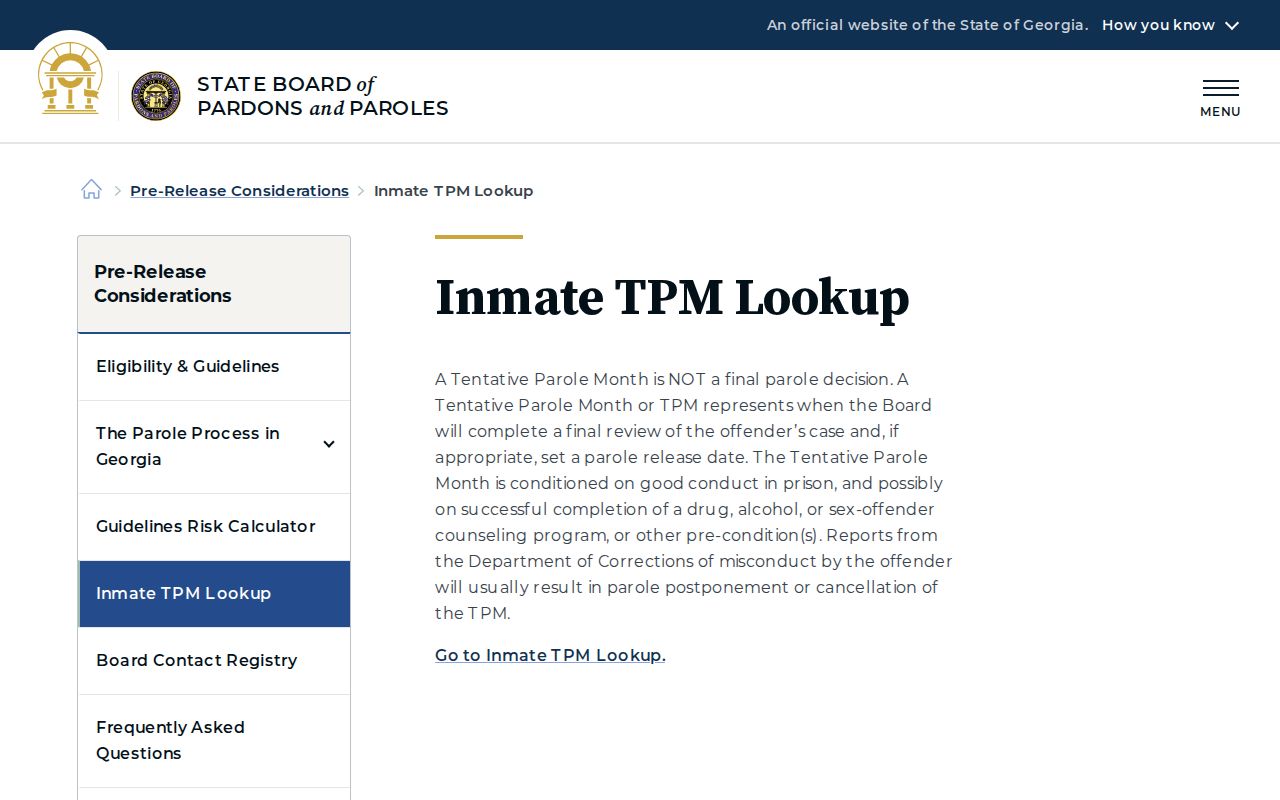
- If the person remains in prison and parole timing is the issue, use the Board's TPM lookup. Do not convert the month into a release day.
- After release, confirm the event through the custody record, court, or parole record rather than relying only on the old projection.
The main Randolph County released inmate search connects sheriff, court, and transfer records. Search failure does not prove release. It may mean the name is spelled differently, the person was moved, or the chosen system never held the person.
The official GDC query form shows the fields available for a state-offender search.
Randolph State Release Date Labels
Similar-looking fields answer different questions. A reader should preserve the exact label when taking notes or requesting correction. Calling every field “the release date” can turn a review month into a false promise. GDC also warns that its public information may not be complete or error-free and directs verification questions to Inmate Records and Information at P.O. Box 1529, Forsyth, GA 31029.
| Label | Agency | What it means |
|---|---|---|
| Local release date | Randolph sheriff or court | County custody calculation or completed release event |
| MRD | GDC | Maximum Release Date tied to state sentence and custody credit |
| Scheduled release date | GDC or V.I.P. | An expected state release date subject to lawful changes |
| TPM | Parole Board | Tentative month for final parole review, not a release day |
| Actual release | Custody agency | The recorded date custody ended or transferred |
The Parole Board's TPM explanation states that a tentative month is not a final parole decision.
Randolph PIC Release Date Credit
Georgia's Performance Incentive Credit Program can affect some state-prison projections. GDC describes PIC as an incentive and reentry process for eligible offenders. A person can earn up to 12 points through satisfactory case-plan work, education or vocational gains, eligible work assignments, and good conduct. Those points may result in one to twelve months being taken from a TPM or MRD. O.C.G.A. 42-5-101 is the work incentive credit statute.
PIC does not apply to every sentence. GDC lists exclusions that include death-sentence cases, sentences of two years or less, non-parole-eligible or minimum mandatory sentences, seven-deadly-sin cases, and life sentences. Conduct also matters. Disruptive behavior can block participation or slow program completion. A possible credit should therefore be treated as one input to the state calculation, not as a date the public can subtract on its own.
This state program should not be applied to Randolph County Jail. No researched local policy supports promising a set reduction there. For a local sentence, ask the sheriff or court for the calculation, jail credit, release reason, and controlling order.
Georgia Is Not an 85% Rule
Georgia's release-date rules do not fit the simple “serve 85 percent” shorthand used in some states. The Parole Board says most parole-eligible people become eligible for consideration after one-third of the prison sentence. Eligibility means the Board can consider parole. It does not mean release occurs at that point. For crime severity levels V, VI, and VII, Board guidance says the recommendation is one-third of the controlling sentence or the guidelines grid recommendation, whichever is greater.
Specified non-life serious violent felony cases are different. For qualifying crime dates on or after January 1, 1995, Board materials say the person is not parole eligible and must serve 100 percent of the prison term imposed by the judge. O.C.G.A. 17-10-6.1 supplies the serious-violent-felony sentencing framework. The listed crimes include murder, rape, aggravated child molestation, aggravated sodomy, aggravated sexual battery, armed robbery, and kidnapping.
Life sentences also depend on law and offense date. The Board describes seven-year eligibility for certain pre-1995 cases, fourteen years after the 1995 change, and thirty years for covered offenses committed on or after July 1, 2006. Some sentences are life without parole or otherwise ineligible. Life cases do not use the ordinary TPM guidelines in the same way. No single percentage can replace the actual judgment, statute, and Board record.
Why Randolph Release Dates Change
A projected date is recalculated when the facts or controlling decisions change. The most useful question is not merely whether the date moved, but which agency action moved it. That answer points to the right record and avoids mixing county, GDC, and Board events.
| Change | Possible effect | Verify with |
|---|---|---|
| Disciplinary report | TPM postponement, cancellation, or lost program progress | GDC and Parole Board |
| Program or PIC progress | Eligible reduction to TPM or MRD | GDC |
| Detainer or hold | Transfer to another authority instead of community release | Custody agency and requesting authority |
| Resentencing or credit correction | Earlier or later sentence calculation | Sentencing court and custody records |
| Parole review | TPM set, denied, postponed, rescinded, or converted to a date | Parole Board |
| Administrative event | Transfer or another custody-status change | Agency holding the person |
A detainer is a request from another authority to hold or transfer a person. It can mean the Randolph or GDC custody record ends while another custody begins. That is not the same as going home. Court appeals, amended sentences, and jail-credit corrections can also move the arithmetic. Final confirmation must identify both the release date and the destination.
Medical, death, and administrative events can also close or change a custody record without following the expected sentence path. Those entries need careful language. An agency's status endpoint should not be described as a community release unless the record supports that result. When a transfer is shown, search the receiving authority before drawing any conclusion about freedom from custody.
Randolph Jail Dates Follow Court Events
The local jail path is more event-driven than the state prison path. Bond may permit release while the case remains open. Dismissal may end the custody basis. Time served can complete a local sentence. A transfer can end Randolph custody without ending detention. A hold can delay release after another part of the case is resolved. For these cases, the court order and sheriff release entry are often more useful than a projected date.
Ask the Randolph County Sheriff's Office for the booking number, booking date, release date and time, release type or reason, charge and case identifiers, and any transfer destination or hold note that may lawfully be released. Then compare the court docket for the bond order, disposition, sentence, amended judgment, or dismissal. If no fixed record exists, Georgia law does not require the agency to create a new calculation or report.
A bond date also needs care. Posting or approval may occur before the jail completes identity checks, paperwork, property return, and checks for other holds. The court action can authorize release without stating the exact time the person left the facility. Use the sheriff's completed release entry for that final custody timestamp.
Confirm Randolph Actual Release
A notification can help track a pending change, but it is not the full release record. Georgia VINELink release checking may show participating custody records and allow alerts. Randolph County's sheriff site does not confirm that its jail feeds VINE, so an absent result requires a direct sheriff check. For state offenders, the Parole Board V.I.P. line can provide maximum or scheduled release information and parole status when the caller has the required identifier.
After the expected date, verify the actual outcome with the agency that held the person. Ask whether custody ended, a transfer occurred, or a detainer took effect. If the record shows parole, confirm with the Board or DCS. If probation follows, use the sentencing court and DCS for felony cases. The final record is an event, not just an old forecast.